

At first glance, self-managing a short-term rental property can appear relatively straightforward.
Many owners assume the role primarily involves:
- responding to enquiries
- organising cleaning
- updating pricing occasionally
- managing guest check-in
And for some smaller or occasional holiday homes, self-management may work reasonably well for a period of time.
However, as guest expectations rise and competition across short-term rental platforms increases, many owners begin to realise that successful short-term rental management involves far more operational oversight than they initially expected.
The true cost of self-managing is often not just financial — it is operational, emotional and time-related.
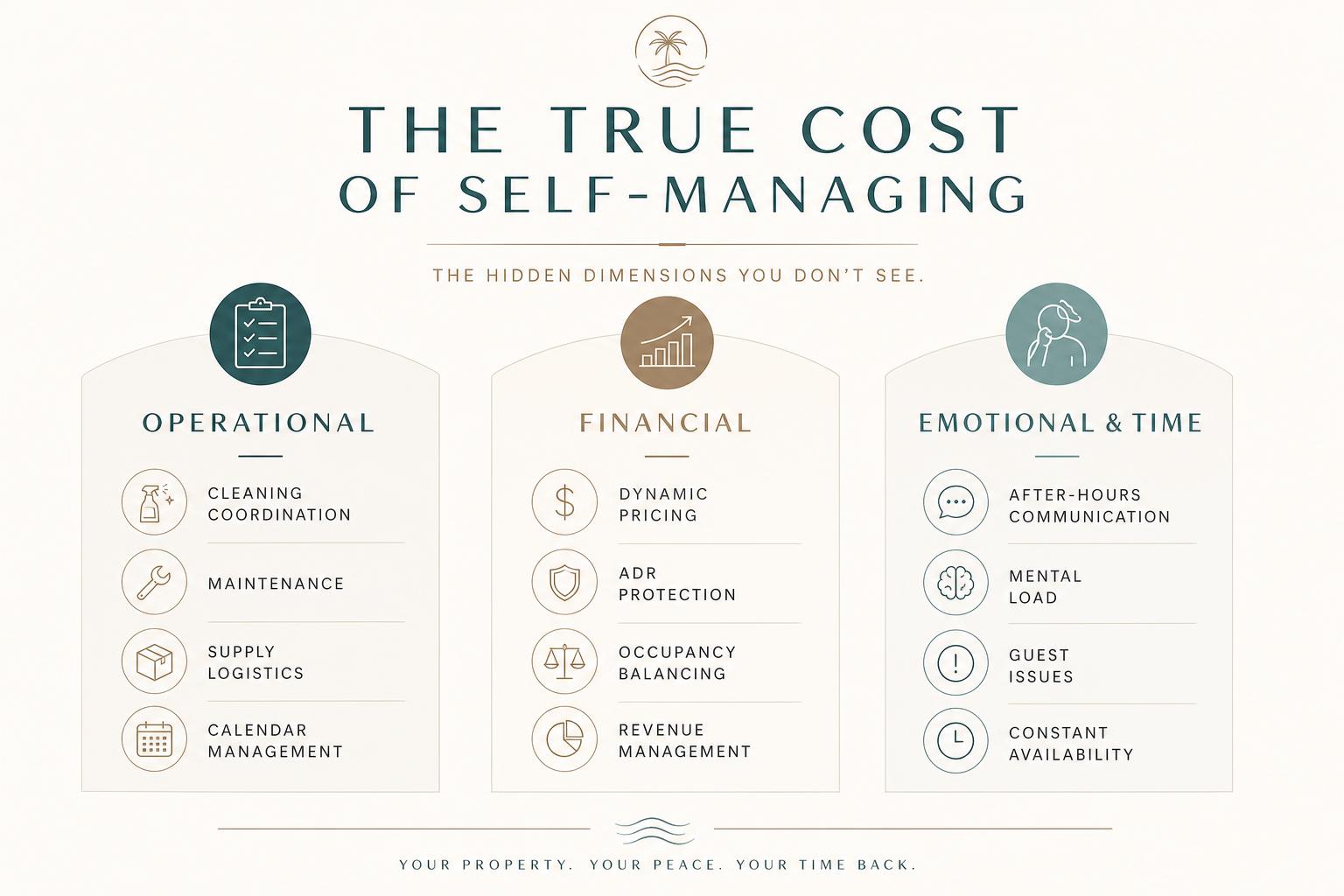
The Time Commitment Is Usually Underestimated
One of the most common surprises for self-managing owners is how constant the operational demands can become.
Managing a short-term rental successfully often involves:
- guest communication across multiple platforms
- pricing adjustments
- calendar management
- cleaning coordination
- maintenance handling
- issue resolution
- review management
- check-in troubleshooting
- after-hours communication
- linen logistics
- supply management
Unlike long-term rentals, short-term rentals operate continuously.
Enquiries, guest issues and operational coordination can arise:
- late at night
- early in the morning
- on weekends
- during holidays
- while travelling
- during personal commitments
For many owners, the mental load becomes larger than expected.
Pricing Strategy Is More Complex Than It Appears
Many self-managing owners rely on static pricing or occasional manual adjustments.
However, short-term rental markets increasingly behave dynamically.
Pricing can shift significantly depending on:
- seasonality
- booking windows
- local events
- school holidays
- occupancy pacing
- competitor behaviour
- length-of-stay demand
- day-of-week compression
Properties that are priced too aggressively may sit vacant unnecessarily.
Properties that are discounted too heavily may increase occupancy while reducing long-term profitability and guest positioning.
Professional revenue management increasingly involves:
- dynamic pricing systems
- booking pace monitoring
- market trend analysis
- lead-time behaviour
- ADR protection
- occupancy balancing
- event-driven demand strategy
This level of ongoing oversight can become difficult for self-managing owners to maintain consistently.
| Pricing Driver | Why It Matters |
|---|---|
| Seasonality | Demand and achievable rates shift across the year |
| Booking windows | Lead time signals when to hold or release rates |
| Local events | Short-term demand spikes justify premium pricing |
| School holidays | Predictable family demand reshapes the calendar |
| Occupancy pacing | Booking speed indicates whether pricing is right |
| Competitor behaviour | Nearby supply influences positioning |
| Length-of-stay demand | Longer stays can lift overall yield |
| Day-of-week compression | Weekend and midweek rates rarely match |
Guest Expectations Continue To Rise
The short-term rental industry has matured significantly over recent years.
Guests increasingly expect:
- hotel-level cleanliness
- fast communication
- seamless check-in experiences
- professionally presented homes
- accurate listing photography
- responsive issue resolution
- reliable amenities
- polished guest experiences
Many guests now compare short-term rentals directly against professional hospitality providers.
This means operational consistency matters more than ever.
Even relatively small issues such as:
- delayed responses
- inconsistent cleaning
- maintenance delays
- inaccurate listings
- supply shortages
can significantly affect:
- reviews
- search ranking
- booking conversion
- repeat business
Cleaning Coordination Becomes Operationally Intensive
Housekeeping is often one of the most underestimated areas of self-management.
Successful short-term rental cleaning now requires:
- scheduling coordination
- quality control
- linen management
- supply tracking
- inspection standards
- turnaround timing
- contractor communication
- issue escalation
As booking frequency increases, operational complexity tends to increase with it.
Last-minute bookings, same-day turnovers and compressed booking windows can quickly create logistical pressure for self-managing owners.
Maintenance Becomes Ongoing
Short-term rentals generally experience:
- higher guest turnover
- heavier usage
- increased wear
- more maintenance exposure
This often creates a constant cycle of:
- repairs
- preventative maintenance
- troubleshooting
- contractor coordination
- replacement purchasing
- emergency response
Owners who self-manage often find themselves handling operational matters well outside normal business hours.
Emotional Fatigue Is Rarely Discussed
One of the least discussed aspects of self-management is the emotional and cognitive load involved.
Many owners find themselves:
- constantly checking phones
- monitoring bookings
- responding to guests late at night
- worrying about reviews
- coordinating contractors
- troubleshooting operational issues
- managing unexpected problems while away
Over time, even successful self-management can become mentally exhausting.
Professional Management Is Increasingly About Systems
Professional short-term rental management is no longer simply about:
- handing over keys
- organising cleaners
- listing properties online
Increasingly, it involves:
- revenue management
- operational systems
- guest verification
- quality control
- compliance oversight
- owner reporting
- hospitality standards
- maintenance coordination
- strategic positioning
The strongest operators now function more like hospitality businesses than traditional property managers.
| Area | Self-Managing | Professional Management |
|---|---|---|
| Availability | Owner on call, day and night | Dedicated team, after-hours cover |
| Pricing | Static or occasional manual edits | Dynamic, demand-led revenue strategy |
| Cleaning | Owner-coordinated turnovers | Managed schedules and quality control |
| Maintenance | Reactive, ad hoc | Preventative and contractor-managed |
| Guest experience | Inconsistent under pressure | Consistent hospitality standards |
| Owner mental load | High and continuous | Largely removed |
The Right Management Structure Protects Long-Term Performance
Not every owner wants maximum occupancy at all costs.
Many owners increasingly prioritise:
- reduced stress
- property presentation
- asset protection
- consistent guest quality
- professional oversight
- long-term positioning
The most successful short-term rental properties are often not simply the busiest.
They are the properties managed thoughtfully, positioned strategically and operated consistently over time.
For many owners, professional management ultimately becomes less about outsourcing tasks — and more about creating operational stability, performance consistency and peace of mind.
Special Stays manages premium coastal and waterfront homes across Perth, Fremantle, Mandurah and coastal Western Australia.